
 This article isn’t about Camp Quest, not really. It’s about preparing to attend Camp Quest AZ for the 5th time. For me, preparation begins early. It doesn’t have to of course but readers of this Blog probably know by now that I believe in proper preparation.
In February, I discussed the elective that I’ll probably be offering this year. You can read about it HERE.
I’m a program counselor which means I help with the camp programs. There are Electives (4 one-hour sessions), Camp Quest Zones (1 one-hour session), and Free Time activities. I’m on the hook for one Elective and to help on other programs. We normally have one “build” Camp Quest Zone and I usually help running that one. Last year all the campers built solitary bee homes. This year I decided to provide the Elective (Line Tracking Car) and the Quest Zone build activity (The FrogBot). I’ll write about the FrogBot in another posting. Now, about the third storage rack that I’m building…
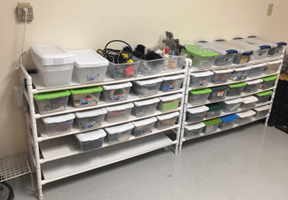 I built my first storage rack getting ready for Camp Quest AZ 2017, the second one when I was preparing for Halloween 2017. Now, I need yet another so that the campers will have a place to store their Line Tracker Robots between building sessions. As you can see the two that I have are in use and quite full.
Each rack holds up to 25 shoe box sized plastic containers and I expect that I’ll have no more that 24 campers elect to participate in the project. The total number of campers will be about 55 and each camper can choose 2 electives. The other electives include archery, fishing, drama, survival skills, dancing, and other fun stuff. So given the fine choices available and the fact that they can only choose 2, 24 would be a very high number.
What’s it take to build? 51.5 ft of ½” PVC Pipe, 36 “T” fittings, 4 “L” fittings, and 4 caps. Plus, political sign material to make the shelves.
After I designed the unit to fit my needs, I bought all the material except the political sign material was free and available. After the last election, I took down all the signs and stored them behind my backyard shed. Next, I cut the PVC into 10-43″ lengths, 10- 10″ lengths, 4-4″ lengths, and 36-2″ lengths. The hardest part of the build is sanding off all the markings on the pipe. What remains is to glue the parts together and make the shelves out of the political sign material. The shelves are two-ply with the flutes of the corrugated plastic sheet running at 90°. In this case, I’ll have to consider where to NOT glue the fittings to allow me to disassemble the unit for shipment to Camp Quest.
 Camp Quest Arizona is not until the end of June but it’s already on my mind and on my workbench. I had super response and success with last year’s program—
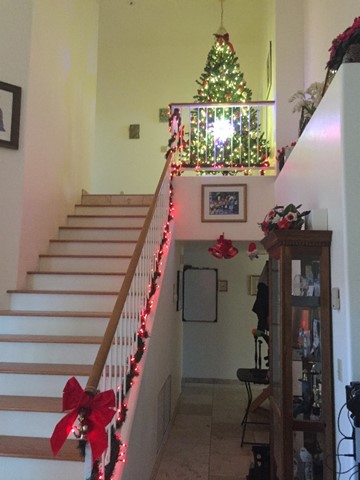 Yes. The Atheist said it, “Merry Christmas!” So, what? It’s Christmas Eve and it’s appropriate. I went to Walmart today to get an HDMI cable and exchanged the greeting with quite a few people today. On the 21st, we celebrated Winter Solstice at our house.


 are very scary to some people. At least one person messaged me to tell me that her
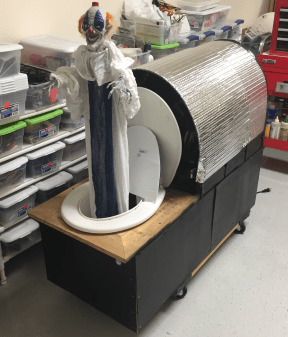 Yes! “It” is done. Please check out the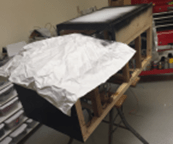
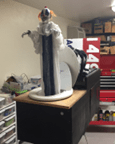 Skinning the prop involved cutting repurposed political signs, attaching the pieces to the framework, and painting them black. The “culvert” is made out of silver colored insulation material laid over bent fiberglass rods. The fiberglass rods are perfect in all ways but one. They are light and easy to bend into a smooth pipe-like shape. What is less than ideal is the fact that they must be handled with gloves. Fiberglass splinters are sharp, painful, and difficult to find and remove.
 Greetings Halloween Geeks and Geeks adjacent! Here is a picture of the IT prop “in-the-bones.” In other words, there is no skin. When I last reported I had everything working on the bench—separately. Turns out that is an important distinction. Everything worked and when assembled, it didn’t. It’s like reverse synergism. I anticipated a problem with mating the store bought jumping spider with the homemade portion. I did encounter that problem and found a solution quickly (and elegantly). Elegantly in that the finished prop will no longer require a set of AA batteries be installed in the spider. The solution was to split power from the main supply, regulate it, and provide it to the spider only when required. It took a bit of fiddling but now works fine. However, I didn’t anticipate that the noisy auto antenna motor would interfere with the audio amplifier.
 seems to fit the situation. Once the spider backs down, the tray moves the spider back and the clown rises once again from the toilet. Beautiful! Except, the voice only worked once and was silent in subsequent cycles. WTF?
 Before I became an electrical engineer, I was an experienced technician. It knew it would take every skill I had to find what was causing this situation. Isolating the audio board power supply didn’t work. Isolating the triggering connection to the audio board also didn’t work. I reasoned that there must be radio frequency interference from the auto antenna actuators.
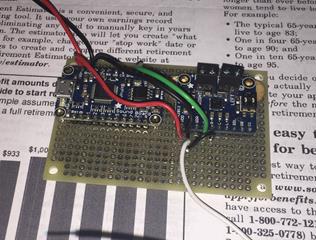
 I finished the last installment of “Building IT” with “what’s next?” What was next was to wire the circuit boards and test their functions. The picture here doesn’t look very different from yesterday but that’s the nature of projects. In the beginning, change is obvious. First there is nothing then there is something. In the middle of the project very little seems to change. It’s like the project absorbs work.
 Greetings! In the 11 days since the last installment of “Building IT” a lot has happened but that doesn’t mean that the work has stopped. Building IT is quite a project. almost to the same level as the first pneumatic clown prop that I built. In some ways IT is a step back. When I retired in 2008, I thought that Halloween was going to be great but it wasn’t. I had “Jack” but the clown prop that I built was a horrible failure. For one thing, I started too late. The clown was supposed to come out of a box. It used and electric actuator that didn’t work well. He was slow and boring. Even so, the Halloween was still fun. I still had my trustworthy “Jack.”
 Building IT is quite a project and projects need to be divided into individual tasks. Some tasks are easy or familiar because I’ve done them before. Some tasks are unfamiliar and challenging. These are the “hard stuff.” On the other hand, there are familiar tasks that must be accomplished first. For example, I’ve built props in the past and building a box is something that might be considered easy or familiar. However I can’t mount the linear actuator which is rather challenging without the box to mount it to.
 The IT build continues. I spent some quality time in my workshop today and got to fiddle a bit with my newest Halloween prop. It is usual for these types of projects to break things first and I had to tear up my new clown decoration. It was necessary to remove his “bones” so that the arms would collapse when sinking into the toilet. It took a bit of work but I got it to function. It’s going to take some finishing work but at least now I know that what I’m trying to do is at least possible.
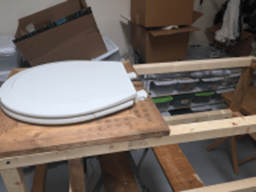 I had to counter balance the toilet lid. The automotive power antenna that I’m using to raise the clown isn’t very strong. The clown’s head will push the lid open. A cord attached to the clown’s neck will make the lid close down when the antenna retracts. It would have been easy to use the clown decoration as it came out of the store if I didn’t require it to pass through a toilet seat but the seat was available and my builds are more fun if I upcycle or at least save material from going to the landfill. Besides, I think the toilet seat adds to the idea that the clown resides in the sewers.
 The normal (starting) position of the clown will be standing in the toilet. Once triggered, the clown will drop down and make room for the jumping spider to slide over the toilet seat. It will then jump at the observer. You can see a video of the clown sinking and rising


