
 Greetings. Here’s a peek behind the scenes of “Lacey’s Scary Graveyard.” If you clicked in the link in the last sentence, you got to see a short film of the graveyard as it appeared in 2017. A friend of mine filmed it and I think he did a great job putting it together. Filming a Halloween Haunt in the daytime is necessary but seeing the “real thing” at night is SO much better. When filming a Halloween Haunt at night, it is difficult to capture the ambiance and the blending of light effects. Daytime filming gives better detail, but nighttime viewing gives you the experience.
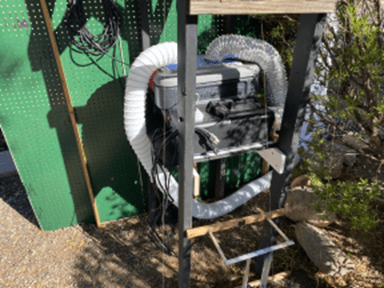
Fog in a Halloween haunt is not essential but when the weather is calm it is good to have “ground hugging” fog around the grave sites. It adds so much to the experience.
Halloween fog machines are simple devices, but they are prone to failure. I’ve not had many that last over a couple of years. Also, the fog that spews from these devices are not inherently “ground hugging.” They must be augmented with “fog chiller” devices that use ice. There are many, many YouTube videos that show how to construct fog chillers. Some use beer coolers and some use trash cans but all of them require the addition of ice. I’ve tried many. I’ve tried the kind that coils a good length of 4″ tubing in a trash can filled with ice where the output of the fog machine is fed into the tube, into the trash can, and out. I’ve also built and used fog chillers where the output of the fog machine is fed into a beer cooler through a hole and the chilled fog exits another hole. In the second version the fog comes into direct contact with the ice.
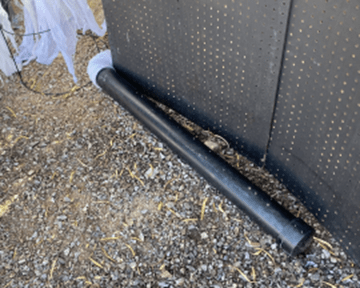
Up to this point, my most successful chiller was a simple tube with small holes drilled in the sides. The tube was filled with ice, capped at the end, and the fog from the machine was fed into the other end. This worked great if the fog machine generated fog and there was ice in the tube. The ice didn’t last long and it was messy.
In 2017, I saw a YouTube video that described a water only fogger that used a fountain mister. The fog was continuous, didn’t require special juice, and used a lot less power than the regular fog machines. In practice, it did produce ground hugging fog but not a lot of it and it seemed to dissipate quickly. I used it but I wasn’t completely satisfied.
This year, I found a YouTube video that combined the two types of foggers, a “Robert’s Fogger.” It looked interesting and did all the things that I needed a fogger to do. Unfortunately, I had invested some effort in making the water only fogger that used a computer fan to blow water mist out of a plastic container. My initial thought was to get a “Y” PVC pipe and combine the outputs of a fog machine with my mist fogger. My plan was to pipe the two streams into the original pipe with the small holes drilled in the sides. If it worked as I had hoped I wouldn’t need ice and I’d still get the ground hugging fog for my graveyard. In the process of testing the hypothesis the computer fan on the mist fogger container failed. So, I removed the 4″ computer fan and inserted a 4″ hose and fed the output of the fog machine into the input. It worked just like Robert’s Fogger did in the video. As bonus, I was doing all my testing on a table so that the output of the mister container was roughly 3 feet below on the ground. In between fog machine pulses, the mist maker continued to deliver fog to the output due to a siphon effect.
I’m looking forward to testing this out this year. I’m hoping that Halloween fog is something that I don’t have to worry about.

 <<<Can you guess the theme of this year’s Halloween display? I’m well into my “silly season” of Halloween preparations. I’ve finished two homemade props so far and bought a few. My workbench has been cleaned from the building and switched over to the electronic fabrication configuration. I’ve brought an old laptop out of retirement, tested a few boards left over from last year, consolidated the components, and I’m about ready to start coding for Halloween Spooktacular activities.
 I started with a DIY video (
 I wanted my next prop to be built around a piece of motorcycle fairing I found in a field a few years ago. I always saw an alien in it. It is not unusual for me to pick up potentially useful “junk” when I’m walking around in the neighborhood. The alien in this piece was too strong to be ignored. For a few years I’ve been tripping over it. Every time I came in to my workshop it would be looking at me and asking me to do something with it. This year the theme of the Halloween display would be about aliens and I knew that if I didn’t use it , it was going to the curb.
 I’m a member of a FaceBook page “Halloween DIY Projects” (
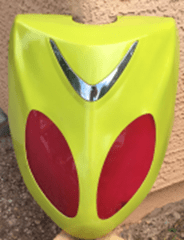 The face was free, but I needed a few more items. The ACE store near my house gave me a few scraps of plexiglass for the eyes. My backyard is full of those puzzle EVA foam mats that I should have thrown away years ago. I had some Dollar Tree scraps. I only needed to
  buy some PVC piping and connectors and they cost me less than $20.
  Now to add the voice!

 Hello readers! Are you as frustrated as I am? It seems frustration is a way of life now that we’re under the current administration.
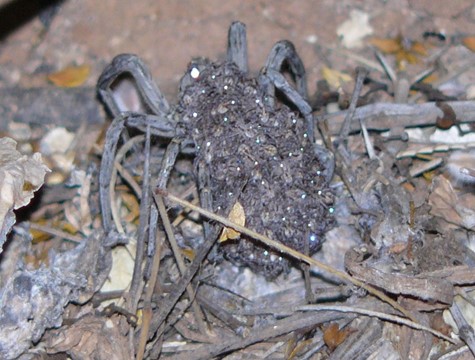 Coming off a natural high after spending a week at Camp Quest Arizona. Spiritually, I’m doing great. Physically, not so much. Every year recovery takes a wee bit longer. I missed a 4th of July party and opted to spend time with Nancy in front of the TV. We enjoyed a dinner of hot dogs, pork and beans, and potato salad. I could hear the fireworks, but the Lazy Boy was so comfortable…After a bit, I had to get up and walk. I like to walk four miles every day, and this time of year it’s best to walk after dark. I usually start at 9 P.M. and it takes a bit less than 90 minutes. This time, I took my Panasonic Camera. Normally, I only have my phone camera, but the last couple of days my headlamp was illuminating Wolf spiders that were carrying their babies on their back. I really needed the camera that has an optical zoom so I could hopefully capture momma spider and her babies. I’ve included one of the best pictures, but it really doesn’t do it justice. When wearing a headset, the Wolf spider eyes reflect very brightly. The momma spiders have a few dozen extra eyes and the effect is awesome when I’m wearing a headset. I’ve been trying to capture the image on the iPhone camera, but the effect was disappointing. Also, the momma spider would jump into her hole while I was setting up the shot.
 The Camp Quest AZ mythical creature is Muggy—a bipedal humanoid wild creature thought to be a native of the Mogollon Rim. Every Camp Quest has its own mythical creature. I believe when Ed Kagin first started Camp Quest in 1996 in Boone County Kentucky for the children of secular families he played a game with an invisible unicorn in his garage. It was a challenge aimed at showing that a negative could not be proven. Back then, there was only one location for Camp Quest. Now, there are 14. Camp Quest Arizona is one of them.


 The other “maker” elective was Rockets. Lauren taught her group how to build and launch rocket made from old soda bottles. This was the first year for this program and the campers that selected it had a great time building and launching their rockets.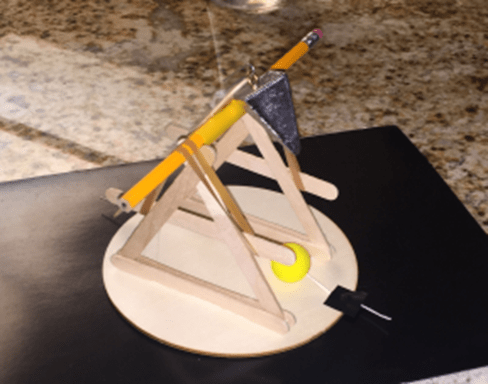
 It seems like all I write about in this blog, when I bother writing, is about Camp Quest. It’s not like that’s all I do but it is the highlight of my summer. At the time of this writing I’m about two weeks from taking the trip to the higher elevations of Arizona and the Piney woods of Prescott National Forest. While I’m there, the phone connection will be spotty. I’ll have to climb up to a ridge to get enough “bars” on my ATT phone to download podcasts and call my wife. That’s not a complaint; that’s a feature! I suppose the 3-minute cold water shower is a feature too.
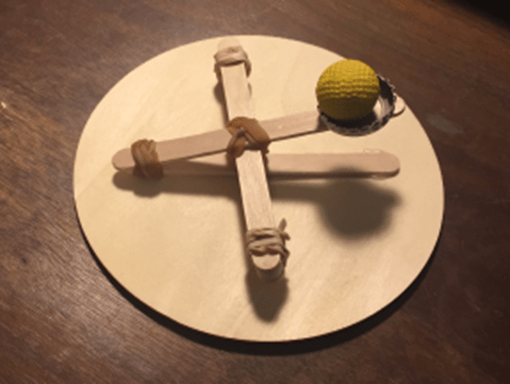
 common materials such as Popsicle sticks, tongue depressors, fishing sinkers, rubber bands, and plywood circles. We’ll also be using hot glue so the building should go quickly.
 The two models to the left normally decorate my home office. Both are capable of hurling metal balls about 30 yards, but you’ll notice that the Mangonel on the left in the picture is sturdier in construction. It uses twisted nylon rope to store the energy. There is very beefy stop in the front of the throwing arm to stop its forward motion and loose the payload. There is a lot of potential energy left in the system once the missile flies. On the other hand, all the potential energy in the Trebuchet is expended and transferred to the missile. Therefore, the device can be built a bit lighter.

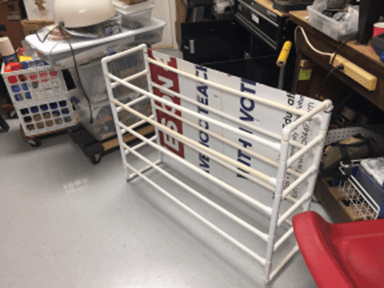
 Camp Quest Arizona 2019 will be the end of June, but preparations have already begun. It’s a very busy week and proper preparations allow me to and the campers to get the most out of the experience. For the last three years, I’ve been building a simple set of shelves to take with me to camp. They consist of ½” PVC pipes and fitting along with repurposed political sign material—coroplast. Pictured are the three sets from the previous years. As you can see, they are full of stuff. My workshop always remains in a state of “organized chaos.” The hoarder quantity of raw materials contained there are sorted and labelled so that I have to spend less time looking for that all important widget that would be perfect for my most recent doo-dad. I’m sorry for all the technical jargon so let me briefly explain…my most recent “doo-dad” might be a Halloween prop or a cleaver way to ignite the fire at the beginning of the annual Winter Solstice celebration. In any case, now that the stuff is all sorted and labelled it doesn’t make sense to undo that. Therefore, I must build another set of shelves for this year’s camp. I’m running out of wall space however. So, what to do? This year I’m going to build a 10 shelf (taller) unit and transfer the containers from one of the shorter units to the bottom of the taller one. I only need 25 or so containers and the taller unit will hold 50. If I do this properly, I’ll pack away the disassembled smaller unit so that it won’t be used and full of
  Here is the new 10-shelf framework.
 Camp Quest AZ 2018 was the last week of June. There were 46 campers this year. The youngest was 8, the oldest 17. This was the 6th year for the camp and my 5th year as a volunteer program counselor. Program counselors are charged with providing the activities such as fishing, archery, survival skills, etc. There are also cabin counselors that are charged with the campers from a specific cabin. The campers are divided into their cabins by age and gender. Older campers assist the volunteers though a program called the Leadership Track. These LTs spend time at camp developing and running activities such as team games and the “Carnival”—an exceptional effort which includes music, games, face painting, balloons, and prizes. This year, one of last year’s LTs came back and did an excellent job as a volunteer camp counselor. Knowing that gave me a good feeling about the future of Camp Quest AZ.
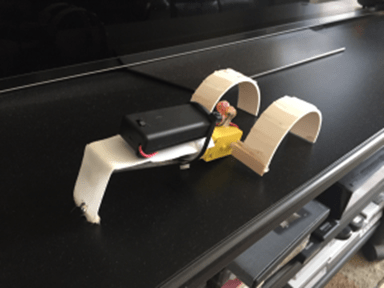
 The FrogBot was designed to be built in 45 minutes and involved the use of only a hot glue gun. The Line Tracker Car was from a kit which took about 4 hours to build. The campers used soldering irons and small hand tools
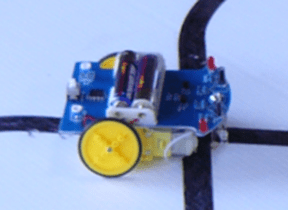 .
.


 AZAtheist's Blog