
 It’s been a week of driving for Nancy and me and our ’97 Thunderbird “Atheist Mobile.” Normally, our old cruiser sits in the driveway collecting dust and tree sap but we got a chance to clean it up, fuel it up, and drive it to and from Phoenix three times this week.
On Saturday, the Secular Coalition for Arizona had its first summit meeting at the headquarters of the Humanist Society of Greater Phoenix in Mesa. In general, it was a good meeting and the talks held my interest. There were a couple of our state representatives in attendance along with the coalition’s professional lobbyist. The presentation by a representative of the Arizona ACLU contained a historical perspective and new information to consider when thinking about secular concerns and the Arizona legislature. A young representative from Equality Arizona stressed the importance of a personal story when persuading legislators to consider the secularist’s perspective on pending legislation. Another board member covered the facts, data, and current trends that affect our goal of rational, reasonable, and secular based laws and regulations. Our lobbyist related her successes and near misses along with a prediction of where we might need to focus during the next legislative session starting in January 2016. Secular Coalition board members and the two state representatives then answered a few questions and a secular candidate for public office was introduced. After the general meeting, the liaison representatives from the individual organizations that comprise the coalition met to discuss strategy and set priorities.
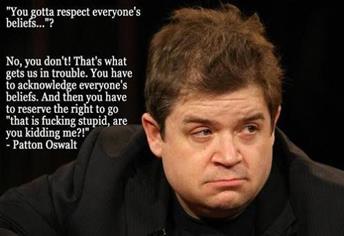
It was a good meeting—except for some preaching done in the early going. Part of the introduction included the line, “We must respect other people’s beliefs.” In the words of Patton Oswalt, “No, you don’t!” For example last year the Arizona legislature passed SB 1062 that contained the belief that one person’s religious conviction should allow a person to discriminate against others. I don’t respect that belief! Even Justice Scalia says, “To permit this would make the professed doctrines of religious belief superior to the law of the land, and in effect to permit every citizen to become a law unto himself.” (If you’d like to view what Patton Oswalt’s has to say on the subject, you can view it HERE.) In order for a belief to be respected it has to be based on rational, reasonable, and scientific principles.
Dave Silverman made this point during his presentation at ASU on Thursday. He is currently on a book promotion tour and Phoenix was one of his early stops. His new book is: Fighting God: An Atheist Manifesto for a Religious World. The Secular Student Alliance of the ASU hosted the event. Dave’s 90 minute presentation started at 7:30 PM. Afterwards, he answered a few questions and then sat down to autograph the books as they were sold. (If you are interested in buying one of his books, I have a few signed copies left over. Contact me at AZAtheist@cox.net and I’ll give you a great deal.)
Dave loves data and results but he can also tell a story. He told a story about his Muslim friend. His friend told Dave that he respected his Atheism and his reasons for being an Atheist. He appreciated the fact that Dave supported his position through careful and rational thought. Then his friend asks, “Now that I’ve told you how I respect your position can you respect my Muslim faith?” Dave told him no. Now they are no longer friends. Dave explained to the crowd that he’d rather lose a friend than to be the President of American Atheists that reinforced unsupportable beliefs. Firebrand Atheism is not about disrespecting people but ideas are fair game. For beliefs to be respected they have to be supported. He’s not alone. Wikipedia also believes that just saying something doesn’t make it so. They call asserting something without explanation or demonstration an empty assertion.
 I made it! Sorta. This year I decided to take my Halloween adventures into the world of Arduino. I saw the “Talking Arduino Halloween Skeleton” on the Instructables.com website. Halloween is the best time of year for a retired engineer and tinkerer like me.
 Naomi the talking witch started out as a standard Halloween hanging prop made in China. The original prop had a voice box and glowing eyes but the voice was hard to understand. I keep everything so perhaps the voice box will be used in a future project. I
  really wanted her face and hands but I ended up using everything except for the voicebox.
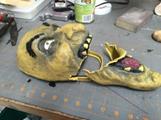
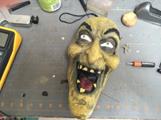
 The project involved building an audio circuit board for the Arduino and making some special WAV files for her voice. The board went together rather quickly and worked well. My wife Nancy recorded the witch’s voice clips and did a great job. There were challenges. The witch’s face was a solid chunk of plastic and I wanted her jaw to move when she spoke. So I had to perform plastic surgery, for real! I used a hot knife which is a #ll Exacto blade mounted on the end of a soldering iron. This made the job easy. The hot blade works its way slowly through the
  plastic but doesn’t take a lot of force.
 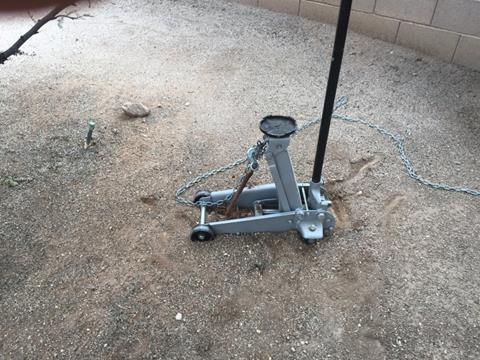 It turns out that that is enough. The trick is that the first several inches of pull are done with the jack over the stake and the remaining extraction is done with the stake in front of the jack. I was able to pull 3 stakes completely out without digging in less than 45 minutes. The fourth one I pulled with the jack after the motorcycle lifted failed. It is the mangled one in the picture. (
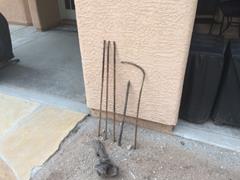 Hopefully, this is the last time I’ll mention pulling stakes in this blog but I hope maybe a couple are interested in some of the details.
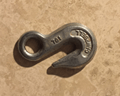 from the hardware store, some chain, a small bolt, a couple of washers, and a nut to fit the bolt. I made a small chain loop around the bar under the lift pad on the car lift using the bolt, washers, and nut. The chain hook was placed over the stake and the chain loop was placed in the open hook. The jack is positioned on top of the stake at first. Once the jack reaches its lift limit, the jack is lowered and re-positioned behind the stake. Upon reaching the lift limit the second time; the stake should be easily pulled out of the ground by hand.
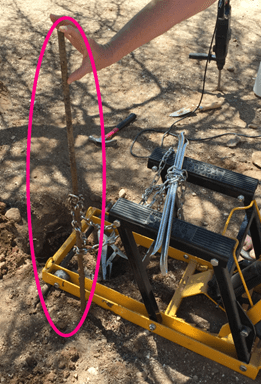
 There is a
  After getting close several times,
 internet! There is power for 12 hours in the day and water enough to drink and shower occasionally (limited to three minutes of tepid water—quite invigorating). The food was good and plentiful and prepared for the campers by a small catering staff. The weather was generally nice but we did have one wet day that started with fog and drizzle but it was only for the one day and the sky cleared up in time for our nighttime stargazing activities which included making an LED constellation, a star treasure hunt, and building a using a simple astrolabe.
 On the list were things like something blue, a rock, a leaf, a feather, etc. I know a feather was on the list because one of the campers chased me down and took my hat.
 I unloaded, set up, and tested the track. Then it went back into the storage box to await its time in the spotlight at the end of the program on Friday. That is when the campers who chose to build Pinewood racers would compete in front of the whole camp.

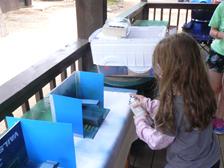
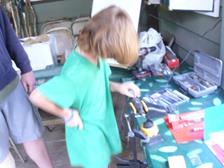

 Everything worked! The six campers that built cars each raced six times. The oldest boy in the competition became the race official and lined up the cars on the track behind the starting gate. He made sure the rotation was proper during the next race. I operated the computer and tallied the scores. After each race, the kids retrieved their cars and they
 were lined up for the next race. It went quick. Each race only takes a couple of seconds. After six races the numbers were in. The computer sorted out the scores and one car came out on top with 6 first place wins. That car belonged to the youngest and littlest Camp Quest camper. Everyone cheered as Gloria was crowned the 2015 Camp Quest Pinewood champion! Congratulations Gloria and congratulations Camp Quest AZ for another successful year.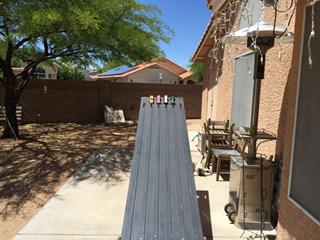
 This is the penultimate chapter on the Pinewood Derby track a friend and I built at Edwards AFB when we had kids in Cub Scouts thirty years ago. After getting all the pieces collected, the first step was to test it out. It is 32 feet long. The best place to set it up was on my back porch. After all this time and mileage, it still worked! It had some dings but the electronics still functioned and the cars stayed on track. In the picture you can see the middle four lanes occupied by my son’s three cars and my 54 year old version. Everything worked but it needed to be “freshened” up a bit and the joints needed work. Working with filler and sandpaper I filled the nicks and smoothed out the all-important rail edges. This is the part of working with wood that I hate but it had to be done.
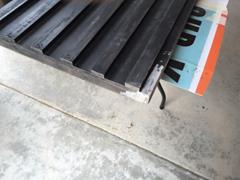
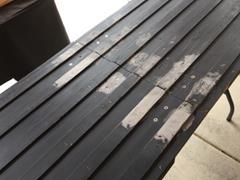
 Also, I’m a bit older bending over is not my favorite thing either but it had to be done…no wait, perhaps not.

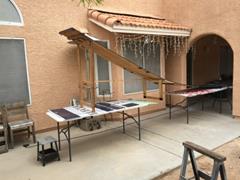
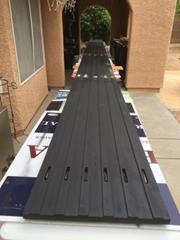 put it on tables. This made the painting and sanding easier. The smoothed out track was then painted flat
 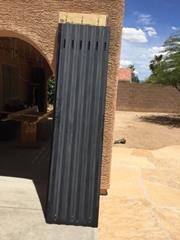 black then I needed to fix an old problem. After the car crosses the finish line, it needs to be stopped. The suggested method is to raise the rail at the end so that the car is lifted off its wheel and rides on the rails. The problem is that most of the cars are slick on the bottom. They have a good deal of speed and frequently don’t stop within the 2 feet provided. The previous solution was to put a section of pipe insulation on the end for the cars to bounce off of. That works but sometimes the cars bounce back and off their rail and collide with other cars on the track. The new solution was to coat the rail after the finish line with rubberized paint. The
  foam barricade at the end is still there but hopefully the cars won’t be bouncing off of it. I’ll tell you if it worked when I return from
  camp.
camp.
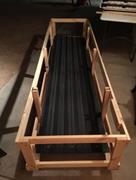
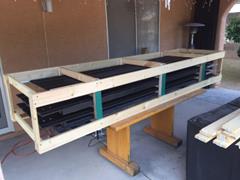 didn’t want to arrive at the camp with new damage. I needed
  a shipping/storage crate. The track pieces needed protection and combined into one package. It would be heavy and it would still be hauled in the back of a truck. My truck has a six foot bed which is 2+ feet too short for the track sections. The packed track would have to be tilted. Also, the access to the summer camp facilities is via a
  few miles of dirt road and I would need a dust cover. OK, still with me? The next step would be to build the crate. Then the crate needed a cover and wheels.
 protection too. Luckily, I didn’t have to build something this time. An under bed storage container from Walmart was all I needed and luckily the packed electronics fit handily in the crate and under the dust cover.
 one is a bit of a surprise and it would spoil it if I attached the picture to this blog. In order to see the 6th car, you’ll have to wait until I
  return from camp unless you’re at camp.
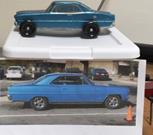
 For three straight years starting in 1984, my son and I participated in his Pinewood Derby. The three cars are pictured are his cars. The car on the left is his first and although we worked on it together, I did a lot of work on the car from beginning to end. The car is extremely tail heavy. It was my idea that having the weight near the rear of the car would give it the most potential energy and make it faster. A Pinewood racer is powered by only gravity and there is a weight limit of 5 ounces. Maxing out on the potential energy along with low friction wheels and a car that seldom touches the guide rail (in other words, a straight running car) produces the fastest cars and the ones that win the races. The aerodynamic shape of the body is also a factor. It turns out that having the weight too far back is a BAD thing because it makes the front wheels light. Track imperfections especially where the track sections come together can cause the front end to bounce. If the front end goes above the rail, the car may leave the track and not finish.
 In 1986, we had our new track with the electronic scoring box. The software allowed each boy to run against every other boy in his den. The top three finishers in each den advanced to the final stage where the boys all competed for the overall trophies. The new track had a special feature that indicated when a new track record had been made. We wrote the name of the boy with the fastest time on an easel each time the record was broken. At the end of the day, my son had won 3rd place overall but his name was on the board for the fastest time. He won two trophies that day! That ended my son’s Pinewood Derby experience. He left on a high note but so did all of his competitors. They got to handle their own cars and raced at least six times. There was no question about the scoring. It was done electronically and fairly. It was a great experience. Lee graduated to Boy Scouts after that and we moved away from Edwards Air Force Base to Dyess AFB, Texas.


 AZAtheist's Blog